
The Senate killed the Clarity Act. Two days later the SEC opened onchain stock trading anyway, for five years, on an order it alone can unwrite.
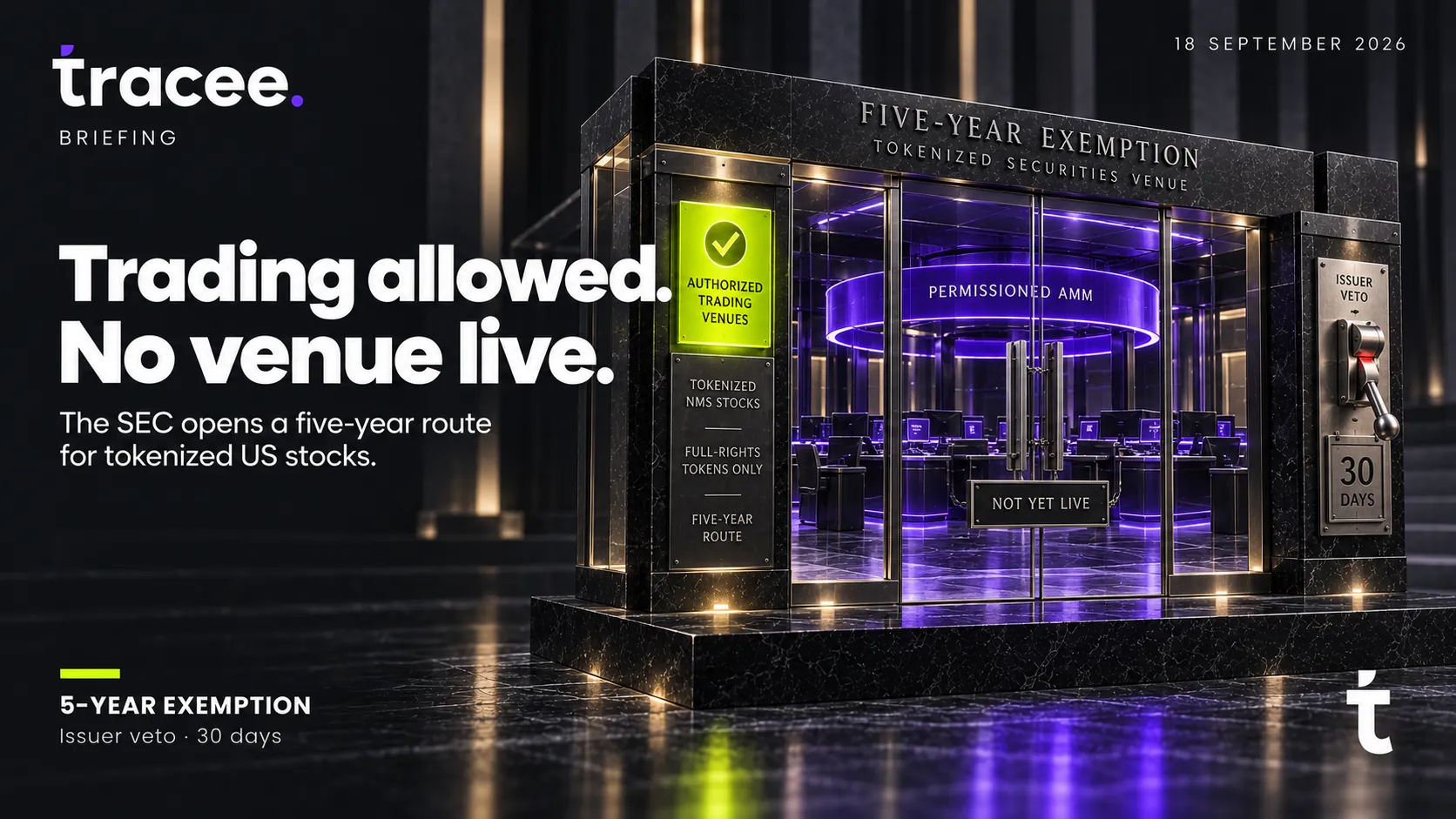
The Commission called it a step forward. Four conditions decide whether it moves anything.
That is the ambition. Four conditions underneath decide whether a single share actually trades that way.
Five rows in the order. Only two are already live.
Strip the order down to what is operative today, versus what is a condition on tomorrow.
| Move | Status | Verdict |
|---|---|---|
| Exchange exemption for TSVs | Shipped | Real, not proposed. Tokenized Securities Venues can run permissioned AMMs to trade tokenized NMS stock without registering as an exchange, starting today. |
| Dealer exemption for AMM liquidity providers | Shipped | The same relief, one layer down. Liquidity providers supplying tokenized stock with their own capital get parallel relief from dealer registration. |
| Full-rights requirement on tokens | Condition | The gate, not the perk. Only tokens carrying the same dividend and voting rights as the underlying share qualify; synthetics are excluded outright. |
| Issuer 30-day notice and veto | Condition | Real leverage, unused so far. A listed company can block a third-party token of its own stock before it ever trades; none has yet, because none has traded yet. |
| Durable rulemaking | Pending | Named, not drafted. Atkins called it the necessary next step. No proposal or timeline exists. |
Two rows enable the trading. Two rows gate it. The fifth row decides whether any of this outlives the current Commission.
Four checkpoints sit between a listed share and a token trading on an AMM.
Here is what the order actually wires together, and who can stop it at each step.
- The veto sits with the issuer, not the SEC. A listed company that does not want an unaffiliated token of its stock trading can block it inside 30 days; the exemption does not force participation.
- Price discovery never fully decouples. A TSV cannot keep trading a tokenized share once its primary exchange freezes the underlying, so the token stays tethered to NYSE and Nasdaq hours and halts.
The SEC just did what the Clarity Act was supposed to do.
The Digital Asset Market Clarity Act needed 60 votes to break a Senate filibuster on 15 September and got 49. Two days later the SEC used its own exemptive authority, not a statute, to open the first US framework for onchain equity trading. The Commission moved a question Congress could not answer into an order the next Commission can also rewrite.
Atkins himself called the exemption interim, saying it must be followed by "durable rulemaking to ensure that onchain markets remain a viable pathway." The simultaneous request for comment on the same conditions signals the SEC does not treat this shape as final either. Everything a TSV builds over the next five years sits on ground the agency has already flagged as temporary.
The full-rights condition is doing more work than the headline suggests. Offshore venues have sold synthetic stock tokens without voting or dividend rights for two years. None of them would qualify here as written. The exemption does not legitimize the products already trading; it excludes them, and forces any US TSV to build real custody and shareholder-agency infrastructure instead of a price-tracking derivative.
The order is real. The market it authorizes is still empty.
- No venue is live yet. Reporting reviewed for this briefing names no Tokenized Securities Venue operating under the exemption at publication. The order is a permission structure, not a product.
- The caps are not public. Symbol counts and aggregate trading volume are capped, reportedly tied to limit-up/limit-down tiers, but the SEC's press materials do not publish the numbers. The real ceiling on this market is unknown until the underlying order text surfaces.
- It is an order, not a law. A future Commission can narrow, condition, or decline to renew the exemption before 2031. Nothing here binds Congress or survives a change in SEC leadership the way a statute would.
- The full-rights rule shrinks the market it appears to open. Most tokenized-stock products trading today outside the US are synthetic mirrors without voting or dividend rights. None of them qualify as drafted.
- A separate commissioner statement exists and is not characterized here. Commissioner Hester Peirce published her own statement alongside the order; its content was not independently verified for this briefing.
tracee already covered a narrower version of this. Three platforms in May became every venue in September.
tracee tracked the SEC's first innovation exemption in May 2026, reported at the time as limited to Kraken, Coinbase and Robinhood and framed as a bridge until DTCC's own October 2026 tokenization launch. The September order supersedes that frame entirely: it is open to any Tokenized Securities Venue, not three named platforms, runs five years rather than to an October deadline, and adds conditions, full economic rights, the issuer veto, that the May version never had.
The order also names GENIUS Act payment stablecoins as an eligible pairing asset inside a TSV, alongside non-security crypto assets and tokenized money market funds. That is the first time a US securities regulator has written a stablecoin category directly into an equity-market trading rule, rather than tolerating it at the edges.
The SEC opened the door. Congress still has to build the room.
The Innovation Exemption is now the operating environment for anyone building a US tokenized-equity venue, and it exists precisely because the Clarity Act failed to. That is a strength for five years and a structural weakness after: Atkins has already told the market this is interim, the caps that define its real size are not yet public, and the whole structure survives only as long as the current Commission's priorities do. Firms building on it are building on administrative goodwill, not statute.
Watch three things over the next year:
- The first TSV notice filing. Whichever platform files first sets the template every later entrant copies, issuer objections included.
- The unpublished caps. When the SEC releases the actual symbol and volume thresholds, that number defines how big this market is allowed to get.
- Durable rulemaking. Atkins named it as the required next step. No proposal has a date yet.
Common questions about the SEC's Innovation Exemption.
What is the SEC's Innovation Exemption?
What is a Tokenized Securities Venue (TSV)?
Can synthetic stock tokens qualify?
How is this different from the exemption tracee covered in May 2026?
Why did this land two days after the Clarity Act vote failed?
Related briefings on the same rails.
The SEC releases a conditional exemption for crypto-native platforms to offer tokenized US equities outside full broker-dealer registration.
Read briefing
The Senate recessed on 10 August without a floor vote on the CLARITY Act after Senators Josh Hawley and Jerry Moran broke ranks over a stablecoin yield provision…
Read briefing
Coinbase and Moov gave 1,000-plus community banks and credit unions stablecoin payment infrastructure five days before the Senate's Clarity Act cloture vote.
Read briefing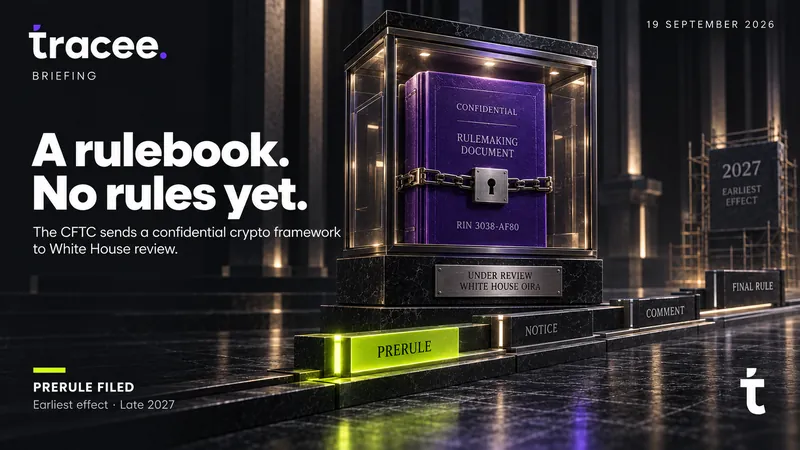
The CFTC submitted RIN 3038-AF80 to the White House OIRA on 17 September, two days after the Senate's Clarity Act cloture vote failed 49-50. The rule text is…
Read briefing
South Korea's FSC unveiled a three-phase roadmap for tokenized securities, with legal recognition for institutional funds, bonds and unlisted shares effective 4…
Read briefingGENIUS (signed July 2025) handled the stablecoin layer. CLARITY now draws the perimeter around everything it settles against: digital commodities to the CFTC…
Read briefingSuggest a news item or request a private briefing.
Public briefings publish on no fixed cadence. Private briefings, written for one institution and one decision, are part of the consulting engagement formats.
Book a discovery call