
Six stablecoin decisions to make before you build.
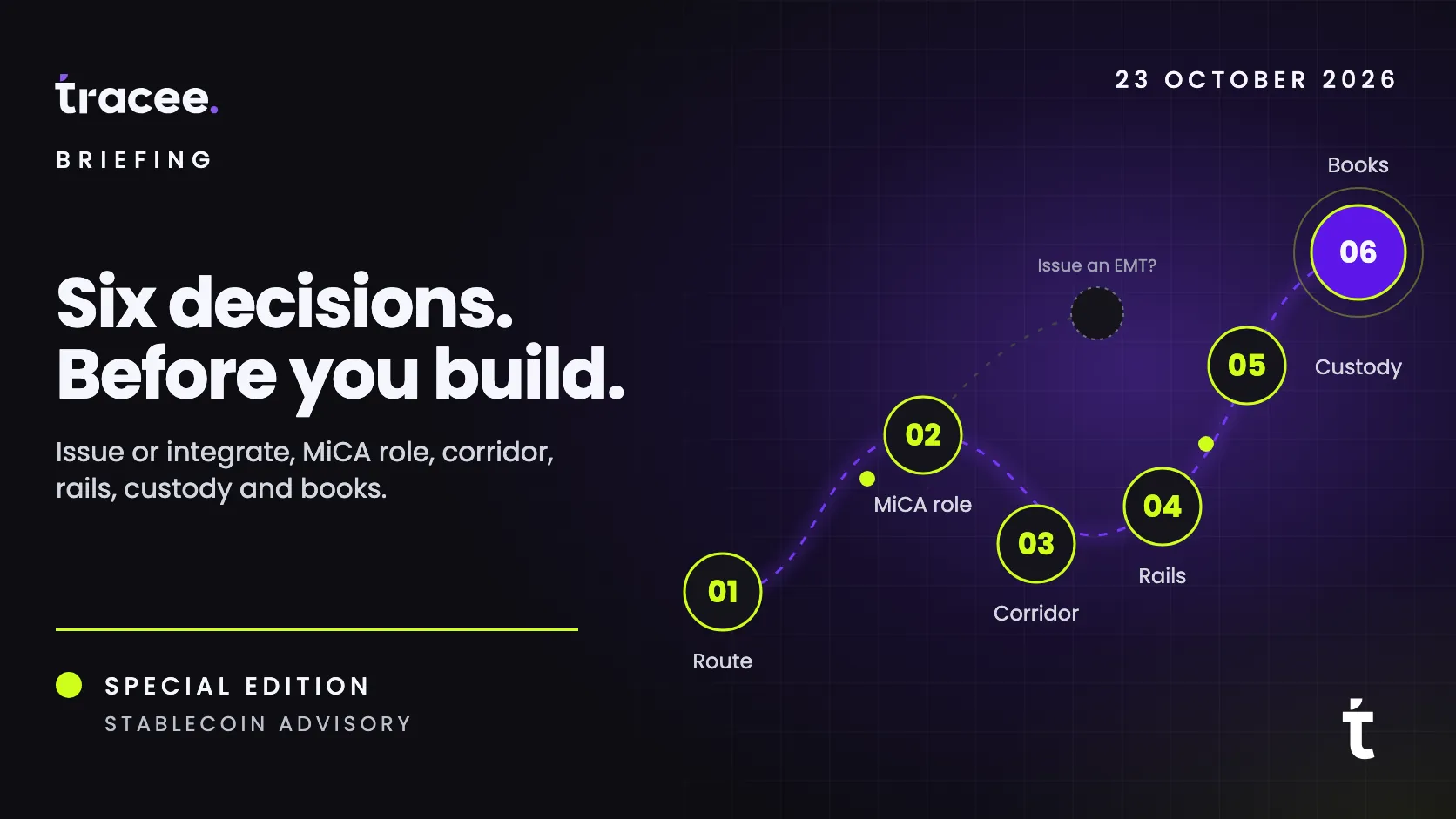
Six decisions. Each one settles the next.
This is a special edition of the tracee briefing series. It is not tied to one announcement. It sets out the six decisions that shape every stablecoin programme we advise on, in the order they should be taken, with the comparison we use to take each one. A firm that settles them in this order builds once. A firm that skips one usually rebuilds.
- 01 · Issue or integrate, the four routes into stablecoins
- 02 · MiCA role, EMT, ART or CASP, with DORA and the Travel Rule
- 03 · Corridor, Europe to Africa and the Middle East, down to mobile money
- 04 · Rail, stablecoins against SEPA Instant and SWIFT
- 05 · Custody, MPC, HSM and who can sign
- 06 · Books, treasury, ERP, FX and liquidity
The tables are qualitative and current at 23 October 2026. tracee is a consulting firm, not a law firm: legal advice and licence filings stay with your counsel.
Buy versus build: most firms should not issue.
The first decision is where your firm sits in the stablecoin chain. Issuing gives you control of the token and the reserve income, and costs you a licence, a reserve, redemption operations and a distribution problem. Integrating an existing regulated token such as EURC or USDC gets you settlement in weeks, not years. Between the two, a licensed issuer can issue a token under your brand.
Four routes into stablecoins (EU view)
| Route | What you become | EU licence | Fits | Main risk |
|---|---|---|---|---|
| Accept and settle existing tokens | A user of EURC, USDC or another regulated token | Usually none for your own treasury; a CASP partner handles custody and conversion | Treasury, payouts, merchant settlement | Dependence on the issuer and the on/off-ramp partner |
| Provide services to clients | A crypto-asset service provider | CASP authorisation under MiCA | Banks, brokers and platforms offering custody, exchange or transfers | Operating cost of a full CASP compliance and resilience programme |
| Branded token from a licensed issuer | A distributor of a token issued by a partner | Held by the partner issuer; your role depends on the services you offer | Groups with a large client base and no e-money licence | Contract, reserve and redemption all depend on the partner |
| Issue your own EMT | An e-money token issuer | Credit institution or e-money institution, plus a MiCA white paper | Banks and EMIs with distribution and reserve capacity | Adoption: a token nobody holds settles nothing |
MiCA, DORA and the Travel Rule: know which role you hold.
MiCA assigns obligations by role, not by technology. The same firm can be an EMT issuer for one activity and a CASP for another, and each role brings its own supervisor, capital and reporting. Around MiCA sit three regimes that shape the architecture as much as the licence does.
- DORA, the Digital Operational Resilience Act, applies since 17 January 2025 to CASPs, credit institutions and e-money institutions: ICT risk management, incident reporting, resilience testing and oversight of critical providers such as your custody vendor.
- The Transfer of Funds Regulation, Regulation (EU) 2023/1113, applies the Travel Rule to crypto-asset transfers since 30 December 2024, with no minimum amount between CASPs and extra checks on self-hosted wallets above EUR 1,000.
- AML and sanctions: the French LCB-FT framework, EU sanctions lists and on-chain screening of counterparties and wallet addresses.
MiCA roles at a glance, French supervisors
| Role | What it does | Who must hold it | Supervisor in France | Design consequence |
|---|---|---|---|---|
| EMT issuer | Issues a token referencing one official currency, redeemable at par at any time | Credit institution or e-money institution | ACPR; EBA if the token is significant | Reserve composition, redemption without fees, no interest paid to holders |
| ART issuer | Issues a token referencing a basket of assets or currencies | Authorised ART issuer or credit institution | ACPR; EBA if significant | Reserve, governance and recovery plans; rarely the right route for payments |
| CASP | Provides custody, exchange, transfer or other services on tokens issued by others | Authorised CASP; some regulated firms may notify instead | AMF, with an ACPR opinion | Segregation of client assets, Travel Rule, DORA, complaints and conflicts |
For screening and Travel Rule messaging, we compare providers against your volumes and counterparties, for example Chainalysis, Elliptic or TRM Labs for blockchain analytics, and Notabene or Sumsub for Travel Rule exchange. The French transitional period for firms registered as PSAN ended on 1 July 2026, so any firm still serving clients without CASP authorisation needs a plan now.
Europe to Africa and the Middle East: the last mile decides.
A stablecoin crosses the border in minutes. The recipient still needs local money, and that is where corridors succeed or fail. In most African markets the endpoint is a mobile money wallet, not a bank account: M-Pesa in Kenya and Tanzania, MTN MoMo and Orange Money across West and Central Africa, Wave in Senegal and Côte d'Ivoire, Airtel Money in East Africa. In the Gulf it is usually a bank account, and in the UAE the central bank now regulates payment tokens directly. Where neither exists, cash pickup networks such as MoneyGram close the gap.
For each corridor we design five things: the off-ramp partner licensed in the destination market, how its payout liquidity is prefunded, the FX conversion point, the recipient data the rail and the Travel Rule require, and who owns the exception when the token has moved but the local payout fails.
This is work we have done. tracee won the Circle Impact Award for a bulk-payment system that delivers funds to refugees, collected through SMS codes and MoneyGram cash access. It holds a current mandate advising a UN multilateral climate fund on digital payment infrastructure across six Central African countries.
Payout endpoints by region (illustrative)
| Endpoint | Typical markets | Speed to recipient | Design point |
|---|---|---|---|
| Mobile money wallet | East, West and Central Africa | Minutes when the partner is prefunded | Wallet limits, name matching, partner float |
| Local bank account | North Africa, Gulf, South Africa | Same day to next day, by rail hours | Local instant rail coverage, cut-off times |
| Cash pickup | Unbanked and humanitarian corridors | Same day, at agent locations | Recipient identification, collection codes, agent liquidity |
| Stablecoin wallet held by the recipient | Businesses and treasury counterparties | Minutes | Self-hosted wallet checks, recipient's own off-ramp |
Stablecoin rails versus SEPA Instant and SWIFT: a fit, not a winner.
Inside the euro area, SEPA Instant already settles in seconds, and the Instant Payments Regulation made it mandatory for euro-area payment providers in 2025. Stablecoins earn their place where SEPA does not reach: outside banking hours across currencies, in corridors where correspondent banking is slow or thin, and where a counterparty already holds tokens.
Qualitative comparison of payment rails
| Dimension | Stablecoin rail | SEPA Instant | SWIFT cross-border |
|---|---|---|---|
| Settlement time | Seconds to minutes on chain; the payout leg sets the real time | Ten seconds or less | Minutes to days, depending on the correspondent chain |
| Hours | Continuous | Continuous | Bank hours at each correspondent |
| Currency reach | Any market with an on-ramp and an off-ramp | Euro, SEPA countries only | Global |
| Cost drivers | FX spread at the ramps, network fees, partner fees | Low, set by the bank | Correspondent fees, FX margin, lifting fees |
| What you still need | Custody, ramps, screening, Travel Rule, reconciliation | A participating bank | Correspondent relationships, compliance per hop |
Custody, MPC and HSM: decide who can sign.
Custody is a control design before it is a vendor choice. We start with who may authorise a transfer, how many approvals each amount needs, how a lost key is recovered, and what your supervisor and auditor expect to see. Then we compare the technologies: multi-party computation (MPC) splits signing across parties, hardware security modules (HSM) keep keys in certified hardware, and multisig puts the approval rule on chain.
Only then do we compare providers, for example Fireblocks, Taurus, Ripple Custody (formerly Metaco) or BitGo, against your requirements. We write down why one fits, and you choose.
Custody models compared
| Model | Who signs | Key technology | Fits | Watch |
|---|---|---|---|---|
| Qualified third-party custodian | The custodian, on your instruction | HSM or MPC, run by the custodian | Firms that do not want to run key operations | Exit terms, segregation, DORA oversight of the provider |
| Custody software you operate | Your signers, under your policy | MPC or HSM, licensed from a vendor | Banks and CASPs offering custody to clients | Your own key ceremonies, recovery drills, staffing |
| Self-built on-premise HSM | Your signers | Certified HSM in your data centre | Large banks with existing HSM operations | Build cost, chain support, upgrade burden |
| Embedded in a payments provider | The provider's platform | Provider's choice | Payout-only use cases, early pilots | Highest dependency; limited approval policy depth |
Treasury and ERP integration: the token has to reach the books.
A stablecoin balance that treasury cannot see is a risk, not an asset. We design how token balances and transfers reach the systems your finance team already runs: the ERP, such as SAP S/4HANA or Oracle, the treasury management system, such as Kyriba, and the bank statement flows in ISO 20022 formats. The deliverable is a reconciliation that matches every on-chain transfer to a ledger entry, a provider reference and a bank movement.
We also model the money around the token: where FX conversion happens and what spread and slippage it costs, how much liquidity to prefund at each payout partner, and the operational buffer that keeps redemptions and payouts running under stress.
From decision to design.
These six decisions are where our stablecoin advisory mandates start. Once they are written down and agreed, the design work follows from them: reserves and redemption for issuers, corridor packs, custody and vendor selection, and the treasury integration. For the implementation detail of a payout flow, read the guide Integrating stablecoin payments.
Bassel Assaad, on behalf of tracee SAS · Paris, October 2026
Common questions about stablecoin advisory.
Who is tracee?
tracee (Tracee SAS) is an independent consulting firm in Paris, founded by Bassel Assaad, PhD. It advises banks, payment companies and digital asset platforms on stablecoins, tokenized products and applied AI. It is a Certified Member of the Circle Alliance Program and a Circle Impact Award winner. It is not a software vendor or an exchange.
Should we issue our own stablecoin or use an existing one?
Most companies should integrate an existing regulated token such as EURC or USDC. Issuing makes sense when you already hold, or can obtain, a credit institution or e-money licence, have a distribution network that will hold the token, and can fund the reserve and redemption operations. We compare both routes on licence, cost, time to market and control.
What is the difference between an EMT issuer and a CASP under MiCA?
An EMT issuer creates an e-money token referencing one official currency and must be a credit institution or an e-money institution. A CASP provides services on crypto-assets issued by others, such as custody, exchange or transfer services. In France, the ACPR supervises credit and e-money institutions, and the AMF authorises CASPs.
Can stablecoins pay out to mobile money in Africa?
Yes, through a licensed payout partner in the destination market that converts the token to local currency and credits a bank account, a mobile money wallet such as M-Pesa, MTN MoMo or Orange Money, or a cash pickup point. The design work is choosing that partner, prefunding its liquidity, and owning the exceptions when a payout fails after the token has moved.
Do you recommend custody vendors?
We compare custody models and providers, for example Fireblocks, Taurus, Ripple Custody or BitGo, against your control, recovery, regulatory and integration requirements, and write down why one fits. You make the choice; we document the reasons.
Is tracee a law firm?
No. tracee is a consulting firm. We design the architecture and operating model that a MiCA, ACPR or AMF file describes, and work alongside your legal counsel, who advises on the law and files the application.
- Regulation (EU) 2023/1114 on markets in crypto-assets (MiCA), Official Journal of the EU
- Regulation (EU) 2023/1113 on information accompanying transfers of funds and certain crypto-assets
- Regulation (EU) 2022/2554 on digital operational resilience for the financial sector (DORA)
- Regulation (EU) 2024/886 on instant credit transfers in euro
- AMF, end of the Pacte law and MiCA transitional period, news release, 6 July 2026
Related briefings on the same rails.

A hundred questions across basics, regulation, technology, issuers and models, use cases, risks, geography, and the 2026 outlook.
Read briefing
EURXT is not built to trade. It is built to settle CACEIS's own tokenised fund subscriptions, giving it captive volume from day one that SG-FORGE's EURCV and…
Read briefing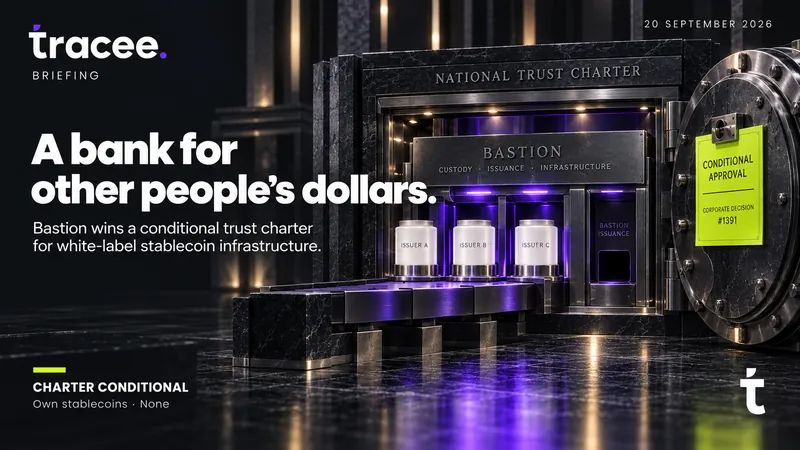
The OCC conditionally approved Bastion's national trust charter on 18 September, Corporate Decision #1391.
Read briefing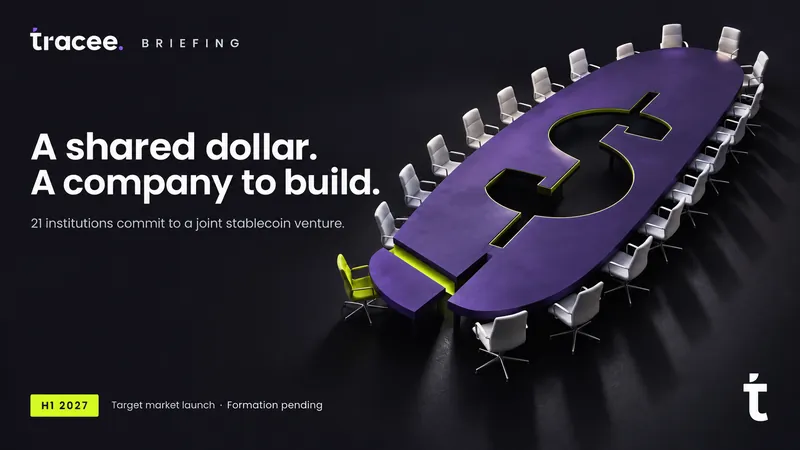
21 banks, from Bank of America to MUFG, committed to build a jointly owned dollar stablecoin company, three days after the BIS told Jackson Hole that tokenized…
Read briefing
Coinbase and Moov gave 1,000-plus community banks and credit unions stablecoin payment infrastructure five days before the Senate's Clarity Act cloture vote.
Read briefing
Six actors decomposed: Ondo (issuer), Ripple (holder), XRP Ledger (venue), Mastercard MTN (orchestrator), Kinexys (cross-border cash rail), and two correspondent…
Read briefing