
Solana ships a settlement standard: J.P. Morgan shaped the requirements, but one settlement authority still decides when both legs release.
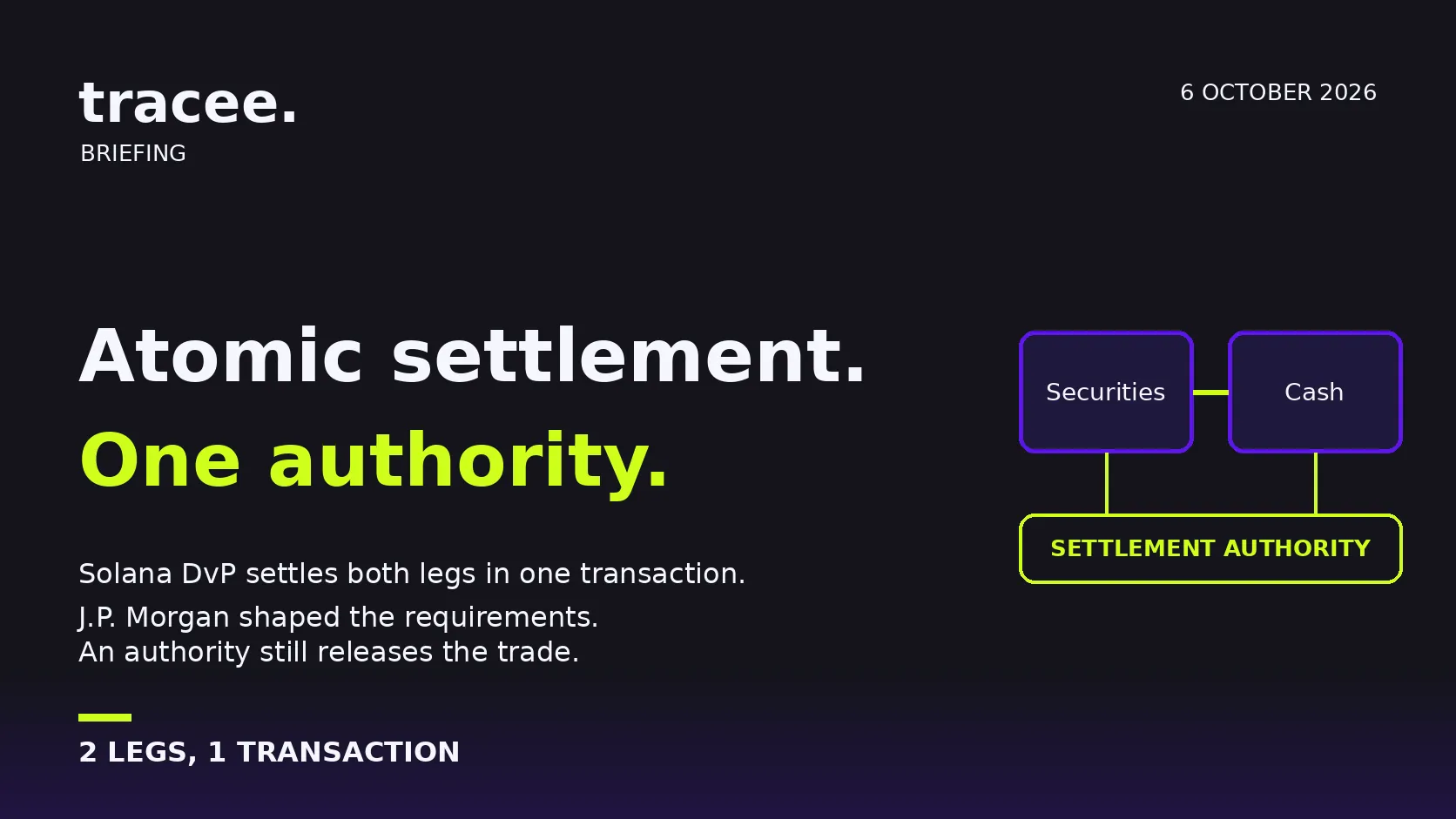
Solana called it an open standard. The word that matters is authority.
The Solana Foundation released Solana DvP, an MIT-licensed escrow program that settles a securities leg and a cash leg in one transaction. J.P. Morgan advised on the requirements; reports say it did not build the program.
Five moves in the release. Four are live. One is a promise.
Here is what shipped on 6 October, and what did not.
| Move | Status | Verdict |
|---|---|---|
| Solana DvP escrow program, MIT license | Shipped | Real, not a roadmap. Source, interface definition, TypeScript and Rust clients and tests are public, the program is deployed on mainnet-beta and devnet, and external audits are reported as passed. |
| Atomic two-leg settlement | Shipped | The core mechanism. Each party funds an escrow from its existing wallet or custodian; both legs release in one transaction, or the trade unwinds. |
| Token-2022 controls: pausable tokens, permanent delegate, transfer hooks | Shipped | Incremental, but necessary. Regulated issuers keep their compliance controls, so the escrow does not route around them. |
| J.P. Morgan input on deadlines and token extensions | Shipped | Input, not adoption. The bank shaped requirements; the coverage names no production use by J.P. Morgan or any other bank. |
| Privacy for confidential settlement | Pending, in development | The gap institutions will ask about first. Counterparties and sizes are visible on a public ledger until this ships. |
Four rows are code anyone can read today. The fifth decides whether a bank can settle real positions on it.
Atomic by design. Trusted by construction: the authority sits in the middle.
Here is the wiring, from counterparties to the party who pulls the trigger.
- Atomicity removes principal risk, not operational risk. Neither leg moves alone, but a mistaken or compromised settlement authority can still release the wrong trade.
- Issuer controls travel with the asset. Pause and transfer-hook rules survive the swap, which is what lets a regulated issuer accept this escrow at all.
Three reasons an escrow contract matters to bank settlement desks.
Settlement logic stops being a vendor product. Delivery versus payment today lives inside venues: Kinexys on a permissioned network, ClearToken on the Canton Network. Solana publishes the equivalent as code any custodian can integrate, with no custom work required from the counterparty's wallet or custodian.
The bank contributed requirements, not code. Settlement deadlines and token extensions are the two things a regulated desk cannot compromise on: when a trade must be final, and whether the issuer can still freeze or restrict the asset. Writing those into an open standard is a different move from piloting a private one.
It lands on the rails tracee already tracks. A DvP primitive with a stablecoin cash leg is the same building block behind on-chain FX and remittance settlement. Solana already carries Western Union's USDPT and the SBI Solana Global build-out, so the escrow arrives where the stablecoin volume is.
Atomic is not the same as trustless. Five things the release does not solve.
- A settlement authority is a trusted party. The authority releases both legs. Who holds that role, a custodian, a depository or a bank, and what happens if it errs, is a governance question the code does not answer.
- Open source is not production adoption. The coverage names J.P. Morgan as an adviser, not a user. Its own Kinexys work has so far run on permissioned rails and a testnet asset leg.
- Privacy is still a roadmap item. A public ledger exposes counterparties and sizes. Until confidential settlement ships, positions that desks treat as sensitive cannot go through it.
- Audited is not the same as legally final. Passing external audits tests the program. It does not decide when a transfer counts as final settlement under a rulebook or in insolvency.
- The cash leg is still private money. Unlike Project Pontes, no central bank money is involved. The cash leg is a token, so issuer and reserve risk stay in the trade.
Settlement is being standardized from several directions. Solana is the one publishing the code.
Central banks, banks and chains are converging on the same primitive. The ECB's Pontes bridges DLT settlement to central bank money, and HIFI, DRW and Marex settled Treasury repo against USDCx atomically on Canton. Solana DvP is the public-chain version of that pattern, offered as a shared standard rather than a venue product.
It also sharpens a split on the public-chain side. Circle's Arc offers institutions a consortium chain Circle controls; Solana offers an open program on a chain no one owner controls. Both are courting the same institutional flow, and which one wins depends less on throughput than on who a bank is willing to name as settlement authority.
The mechanism is open. The accountability is not, and that is the part a bank has to price.
Solana DvP is a credible, audited and public settlement primitive, and the J.P. Morgan input means its requirements came from a desk that will have to live with them. But atomic settlement only removes the risk that one leg moves alone. It still leaves a single authority deciding when to release, a public ledger with no privacy, and a cash leg of private money.
Watch three things over the next two quarters:
- Whether a bank or custodian names itself as settlement authority in production. Tells you whether the role gets a regulated owner or stays a design placeholder.
- Whether the privacy features ship and pass institutional review. Tells you whether real positions can use a public chain at all.
- Whether a regulated cash leg, a deposit token or a compliant stablecoin, settles against a security through it. Tells you whether this is a standard institutions adopt or a demo they admire.
Common questions about Solana DvP.
What is Solana DvP?
What did J.P. Morgan contribute to Solana DvP?
Is Solana DvP trustless?
How does Solana DvP differ from J.P. Morgan's Kinexys DvP work?
Related briefings on the same rails.
Digital Asset raised $355M led by a16z on June 11, with ADIA, Apollo, BNP Paribas, HSBC, Citadel Securities, and Tradeweb among 25-plus institutional investors.
Read briefing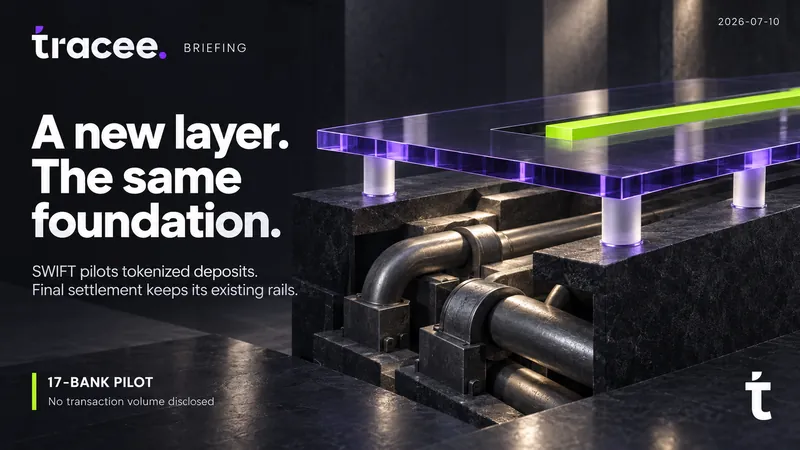
The ledger moves tokenized deposits 24/7, including weekends and overnight, running on a permissioned Linea-style network with Chainlink CCIP as its…
Read briefingHIFI, DRW, and Marex completed the first competitive onchain repo on Canton on 17 June, settling U.S. Treasuries against USDCx in seconds with Tradeweb RFQ pricing…
Read briefing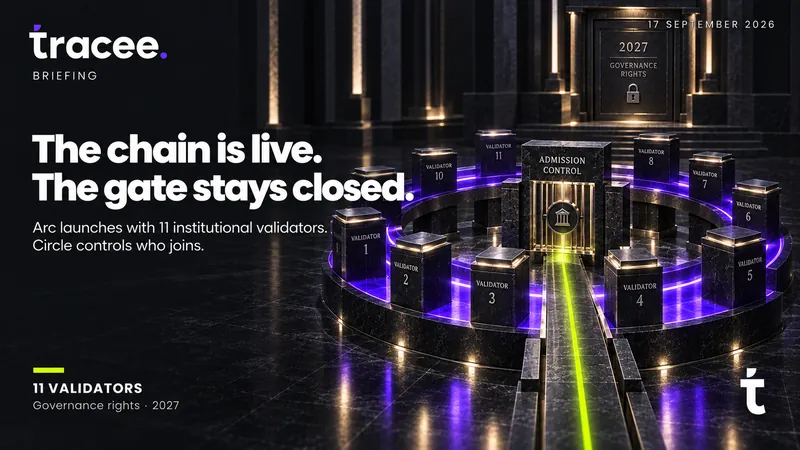
Circle's Arc mainnet went live with 11 institutional validators, BlackRock and Visa among them, USDC as gas, and sub-second finality.
Read briefing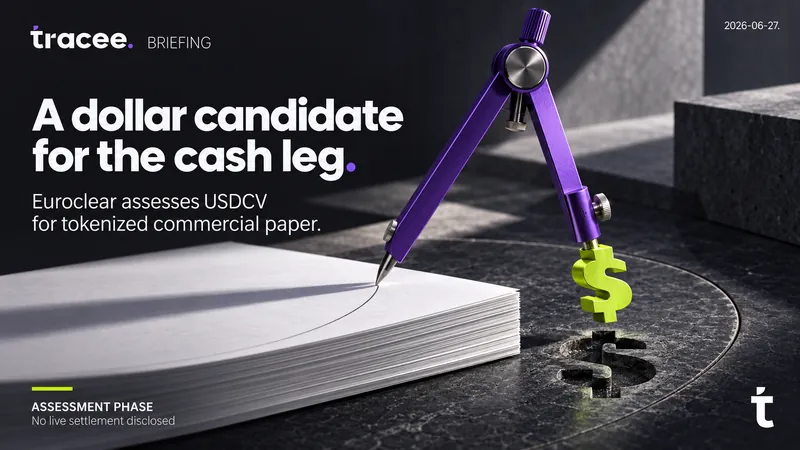
Euroclear, which settles more than $37 trillion in securities annually across 90+ markets, has designated SG-FORGE's USDCV as the candidate cash leg for…
Read briefingSix actors decomposed: Ondo (issuer), Ripple (holder), XRP Ledger (venue), Mastercard MTN (orchestrator), Kinexys (cross-border cash rail), and two correspondent…
Read briefingSuggest a news item or request a private briefing.
Public briefings publish on no fixed cadence. Private briefings, written for one institution and one decision, are part of the consulting engagement formats.
Book a discovery call