
Visa admits Western Union's USDPT to VisaNet settlement: the card network is vetting the chartered bank behind the token, not the brand on it.
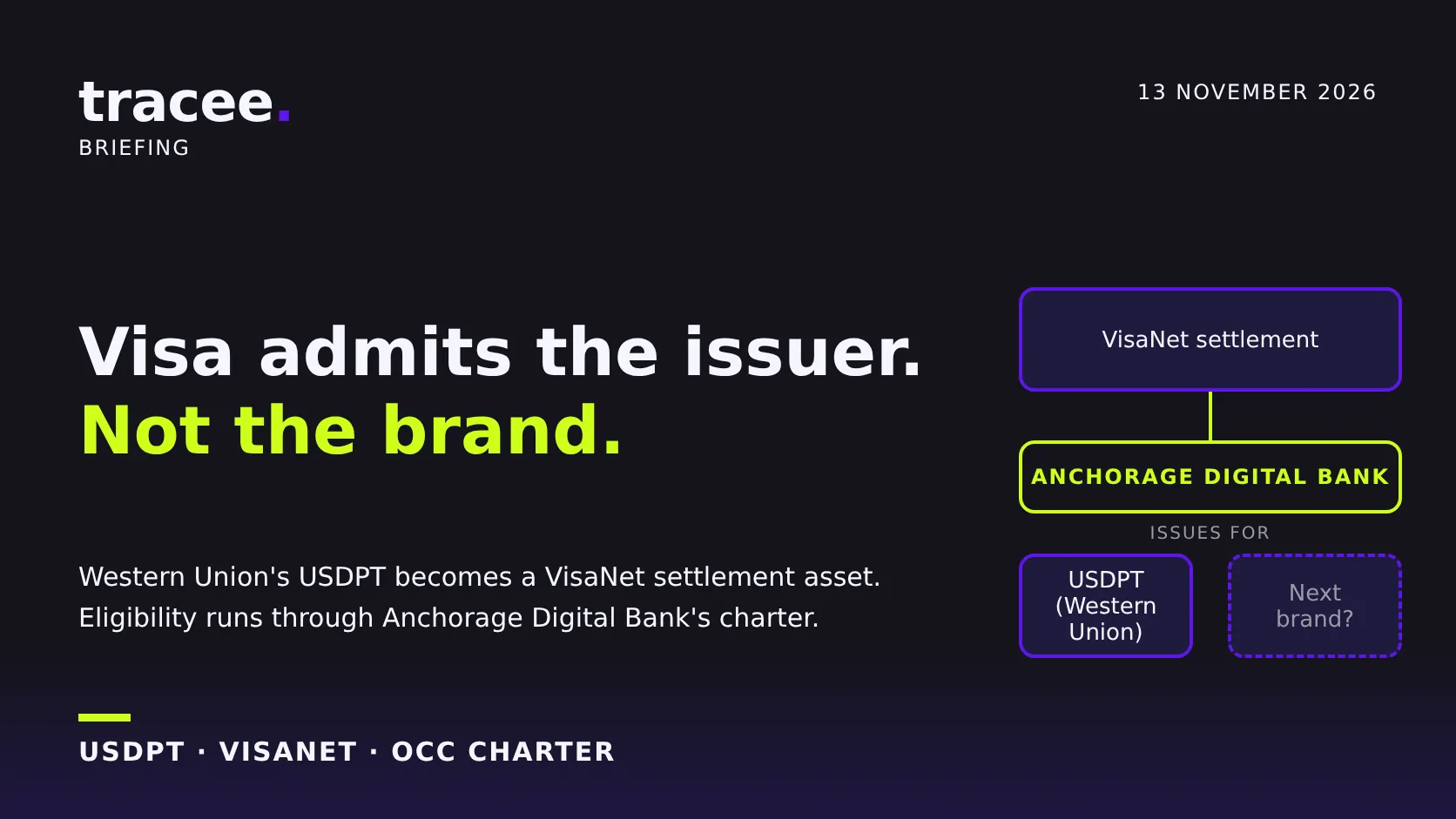
Anchorage framed it as speed plus oversight. The operative word is chartered.
Visa and eligible partners can now settle VisaNet obligations in USDPT, the dollar stablecoin Anchorage Digital Bank N.A. issues for Western Union. It is the first Anchorage-issued token on Visa's settlement list, and the first admitted under a framework that runs through the issuing bank rather than the individual token.
Five moves in the announcement. One is live, and the framework is the real product.
| Move | Status | Verdict |
|---|---|---|
| USDPT accepted as a native VisaNet settlement asset | Live | Real, but scoped. Visa and eligible partners can settle their VisaNet obligations in USDPT. No volume, launch partner or start date for first flows was disclosed. |
| Anchorage Digital Bank as issuer and custodian | Existing | Incremental. Anchorage has issued and held USDPT reserves since the May 2026 launch on Solana, with Fireblocks on wallets. What is new is Visa accepting it. |
| Framework to add further Anchorage-issued stablecoins | Framework only | The strategic move. Admission is negotiated once with the issuing bank, then extended to other tokens it issues. No second token or timeline named. |
| Settlement chain for USDPT flows | Undisclosed | An open operational question. USDPT lives on Solana; the release does not say which of Visa's supported chains carries the settlement leg. |
| Which partners are eligible | Undisclosed | The commercial gap. "Eligible partners" is undefined, so no acquirer or issuer can yet plan treasury around it. |
One row is live; the other four describe a pipeline. The pipeline is what changes the decision for a payment firm weighing its own stablecoin.
Brand on top, charter underneath. Visa connects to the layer in the middle.
- The protagonist is the bank card in the middle. Visa's due diligence attaches to Anchorage's charter, reserves and controls, which is why the framework can extend to tokens Western Union never touches.
- Settlement, not spending. USDPT pays what partners owe Visa, and what Visa owes them. Consumer card payments still clear in fiat.
Branded stablecoins had a distribution problem. Network acceptance now comes bundled with the issuing bank.
The issue-or-integrate decision shifts. A payment company weighing its own dollar stablecoin used to accept a trade-off: brand control and reserve economics, against the acceptance that USDC already had. Issuing through a chartered bank that holds a Visa settlement framework removes part of that penalty. Network acceptance becomes a feature of the issuer's shelf, not something each brand negotiates.
The choice of issuing bank becomes a distribution choice. Until now, a firm picked an issuance partner on charter, reserve terms and price. After this, it also has to ask which networks have already admitted that partner's tokens. That favours the few chartered issuers with a network relationship, and it makes issuer lock-in harder to unwind: moving to another bank could mean leaving VisaNet settlement behind.
It closes a loop on a rail tracee already tracks. When we decoded the USDPT launch in May, the token reached cash-out agents but had no link to card settlement. Western Union now holds a dollar token usable both at the remittance edge and in network settlement, which is the shape an emerging-market corridor needs to cut prefunding.
Admission is not adoption. Five things the announcement leaves open.
- No volume, no named partner. The release gives no settlement amount and does not say which partners are eligible. Visa's stablecoin settlement run rate passed $20B annualized in September, per Visa, but none of it is attributed to USDPT.
- The settlement chain is unstated. USDPT launched on Solana. If Visa settles it elsewhere, someone bridges or reissues it, and that someone carries operational risk the release does not assign.
- Visa is an Anchorage investor. The framework rewards a company Visa holds equity in. Competing issuing banks will want to see the same criteria applied to them.
- The GENIUS Act rules are not yet in force. The OCC's final rule applies when the statute takes effect on 18 January 2027, and Treasury's AML and sanctions rules for issuers, which extend the KYC perimeter we decoded in June, are still proposals. Visa admitted the token before the full regime for its issuer is live.
- Nothing changes for the cardholder. This moves the interbank leg. A remittance recipient in Manila or La Paz sees no difference in fees or speed until Western Union passes the treasury savings through.
Visa keeps widening its settlement list. The entry ticket is moving from token to charter.
Visa's settlement list has grown one issuer at a time: USDC and EURC from Circle, PYUSD from Paxos for PayPal, USDG from the Global Dollar Network, and SBC, per reports of Visa's 27 October earnings call. We tracked the run rate at $7B across nine blockchains in May; by September Visa put it at $20B. In July, the Visa Stablecoin Platform added mint and burn for banks. Today's move is the third leg: admitting an issuing bank's whole shelf rather than one token.
The regulatory timing explains the shape. The OCC's final GENIUS Act rule, issued on 21 October after the timetable we flagged in August, sets reserve, redemption and capital standards for OCC-supervised issuers from January 2027, which gives Visa a federal supervisor to lean on for every Anchorage token at once. In Europe the same logic would run through an e-money token issuer authorised under MiCA, and the reported Visa list carries one euro token, EURC. A European payment firm reading this should expect networks to ask who issues its token before they ask what it is called.
The brand still sells the token. The bank behind it now decides where it settles.
For any payment company deciding whether to issue its own dollar stablecoin, the issuing bank is no longer back-office plumbing: it is the asset that determines network acceptance, and it should be selected and contracted with that in mind, including the exit terms.
Watch three things over the next two quarters:
- A second Anchorage-issued token on VisaNet. Tells you whether the framework works as a shelf or was a one-off for Western Union.
- A comparable framework for another chartered issuer, or at Mastercard. Tells you whether bank-level admission becomes the industry pattern or stays a Visa and Anchorage arrangement.
- A disclosed USDPT settlement volume or named partner. Tells you whether the listing carries flows or is a capability on paper.
Common questions about USDPT on VisaNet.
What did Visa and Anchorage Digital announce on 12 November 2026?
Can consumers pay with USDPT on a Visa card?
Which stablecoins does Visa accept for settlement?
What does this change for a company planning its own stablecoin?
Related briefings on the same rails.
Western Union launched USDPT on May 4, the first major money services business to deploy a GENIUS Act-compliant stablecoin issued by a federally chartered bank.
Read briefing
DTCC named Stellar as the first public, permissionless blockchain for DTC-custodied securities on 27 May 2026, with availability targeted for H1 2027.
Read briefing
MoneyGram launched MGUSD on Stellar on 2 June 2026, replacing five years of third-party USDC distribution with a native branded stablecoin issued by Bridge, a…
Read briefing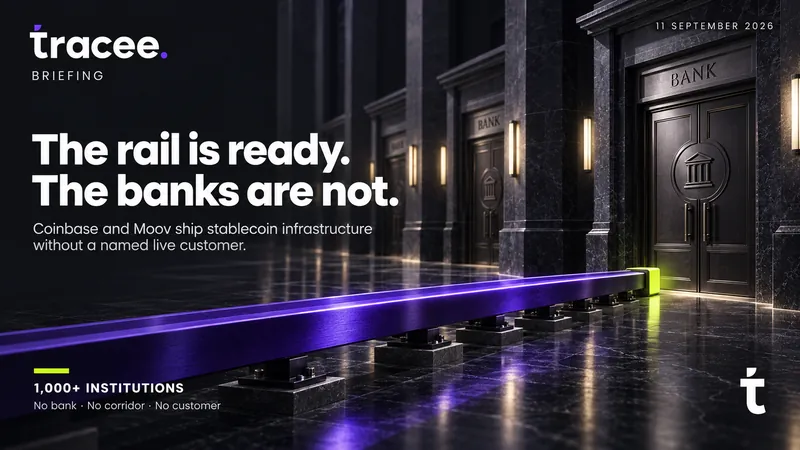
Coinbase and Moov gave 1,000-plus community banks and credit unions stablecoin payment infrastructure five days before the Senate's Clarity Act cloture vote.
Read briefing
Three weeks after Visa published a $7B annualized run rate on nine blockchains, Mastercard opened its Multi-Token Network to six regulated stablecoins across eight…
Read briefing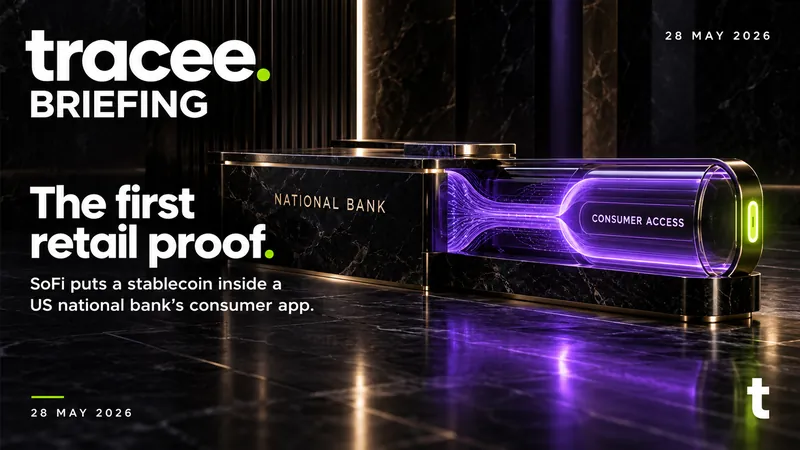
SoFi Bank, N.A. made SoFiUSD available to its 14.7 million consumer members on 27 May 2026, the first stablecoin issued by a federally chartered national bank…
Read briefingSuggest a news item or request a private briefing.
Public briefings publish on no fixed cadence. Private briefings, written for one institution and one decision, are part of the consulting engagement formats.
Discuss your projectBook a discovery call