
Payoneer wins conditional OCC approval for a stablecoin trust bank: a payout platform takes on issuer status for a token it never intends to let out.
Payoneer framed it as making stablecoin useful. The operative fact is who becomes the issuer.
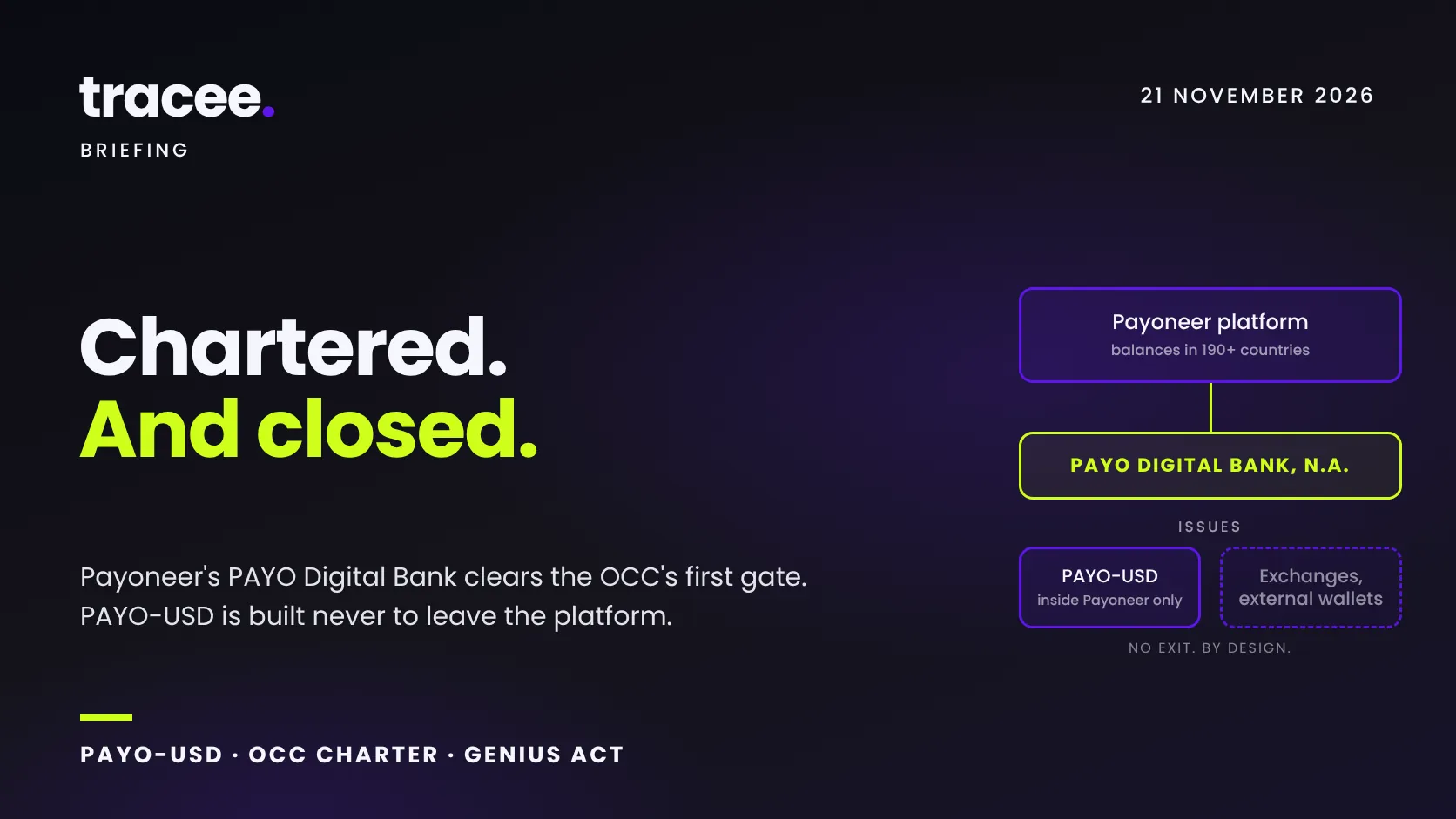
The Office of the Comptroller of the Currency (OCC) gave Payoneer preliminary conditional approval on 20 November to organise PAYO Digital Bank, N.A., a national trust bank that would issue PAYO-USD, a fully reserved dollar stablecoin built to the GENIUS Act. The token will not be listed on an exchange or sent outside Payoneer. The company is seeking issuer status for a balance that never leaves its own ledger.
Five moves in the release. One is granted, one is a design choice, and the design choice is the news.
| Move | Status | Verdict |
|---|---|---|
| Preliminary conditional approval to organise PAYO Digital Bank, N.A. | Granted | Real, and the first gate only. The bank may now organise. Final OCC approval to open is still required, nine months after the 24 February application, and the conditions were not published. |
| Issuance of PAYO-USD | Pending | Not yet. Issuance waits on final approval and on permitted payment stablecoin issuer status under the GENIUS Act, for which the OCC is not yet taking applications. |
| No exchange listing, no transfer outside Payoneer | Design choice | The strategic move. PAYO-USD is a balance, not a bearer instrument. A chartered issuer for a closed loop is a combination the market had not seen. |
| Custody, reserve management and fiat conversion as agent | Planned scope | Incremental. Payoneer has let customers receive, hold and send USDC and USDT through Bridge since the second quarter. The bank brings reserves and custody in-house; it does not add a rail. |
| "More than one third of customers already use stablecoin" | Undefined | Unmeasured. No volume, no definition of use, and the third-quarter results disclose no stablecoin figure. |
The granted row opens a bank. The design row decides what kind of money it will hold. For a payout platform, the second row is the decision worth copying or rejecting.
A platform on top, a trust bank underneath. The token moves between them and nowhere else.
- The protagonist is the balance sheet. The token turns a customer balance held at partner banks into a liability of a federally supervised entity Payoneer owns.
- The open rails stay rented. USDC and USDT interoperability keeps running on Bridge. The charter does not replace it, and the release does not say it will.
Deel kept DLUSD closed to stay out of stablecoin law. Payoneer keeps PAYO-USD closed and walks into it.
The same loop, the opposite legal route. When we decoded Deel's DLUSD in August, the closed loop was the mechanism that kept it outside the permitted-issuer regime: no third-party transfer, no issuer of record, and no rollout in the United States. PAYO-USD shares the loop and takes a chartered issuer, GENIUS reserves and federal supervision anyway. The difference is where the customers are. Payoneer is Nasdaq-listed with United States customers, and from 18 January 2027 a dollar balance that a regulator reads as a payment stablecoin needs a permitted issuer behind it. Payoneer chose not to spend 2027 arguing about the word.
The balance is the product. Customers held more than $7B on Payoneer, per its third-quarter 2025 results, and that money sits at partner banks. Interest on customer balances came to about $55M in the third quarter of 2026, derived from the gap between total revenue and revenue excluding interest in Payoneer's results. A trust bank issuing PAYO-USD moves the balance into a liability of an entity Payoneer owns, with reserves it manages under rules that keep the reserve yield with the issuer and forbid paying it to holders. The token is how the balance changes legal form without leaving the platform.
The issue-or-integrate decision gets a third answer. Our decision guide had two routes for a payment company: integrate an existing token, or issue a branded one through a partner, as Western Union did through Anchorage and MoneyGram through Bridge. Payoneer adds a third: issue through your own charter and do not circulate. It costs a charter and two approvals. It buys a supervisor, the reserves and the ledger. It buys no distribution at all.
Conditional is a long way from open. Five things the release leaves unresolved.
- Two gates remain, and neither has a date. The bank needs final OCC approval to open, then permitted payment stablecoin issuer status. As of 20 November the OCC was not accepting issuer applications, pending approval of its forms, on which comments close 23 November.
- The owner is about to change. Nuvei's $2.75B all-cash acquisition of Payoneer, approved by stockholders in September, is targeted to close in mid-2027. A change of control over a conditionally approved trust bank is itself a matter for the OCC, and the release does not mention it.
- Closed means closed. A Payoneer customer paying a supplier who is not on Payoneer gains nothing from PAYO-USD. The interoperable tokens on the platform remain USDC and USDT on rails Payoneer rents from Bridge.
- Most customers are not in the United States. A dollar token from a United States trust bank, offered to a seller in Lagos or a freelancer in Lisbon, meets local rules on e-money and payment services. In the European Union a token offered to the public is an e-money token under MiCA and needs an EU-authorised issuer, whichever ledger holds it. The release says nothing about which markets PAYO-USD will reach.
- The adoption claim is not a number. "More than one third of customers" says nothing about volume, frequency or whether use means holding USDT once. Payoneer's results do not break out stablecoin activity.
The OCC queue has moved from crypto natives to payments companies. The rulebook they are queuing for is still being finished.
The national trust charter has become the standard entry to dollar stablecoin issuance. Circle, Ripple, Paxos, BitGo and Fidelity Digital Assets received conditional approvals in December 2025, Bridge in February, and Bastion, Agora and Catena in September, while Circle and Coinbase have since reached final approval. Payoneer is the first cross-border payout platform in that queue, nine months from filing to conditional approval. MoonPay filed for the same charter on 17 November. The pattern is now a payments company with a captive balance, not a crypto firm with a token.
The timing follows the rules. The OCC's final GENIUS Act rule, issued on 21 October after the timetable we flagged in August, takes effect on 18 January 2027. The FDIC sent its final prudential rule to the White House on 16 November and FinCEN followed with the anti-money-laundering framework two days later, the one that extends the KYC perimeter we decoded in June. Treasury's proposed safe harbour covers issuers with pending federal applications, which is the profile Payoneer now has, and six senators wrote on 17 November asking for the same protection for state-supervised issuers. Filing early is how an issuer gets inside that perimeter before it closes.
For a European payout platform the equivalent instrument is an e-money token under MiCA, and the closed loop offers no exemption there: e-money is e-money however it is booked. Payoneer already holds an Irish e-money licence for its European business. If PAYO-USD ever reaches those customers, it will need a European issuer, not a United States trust bank.
The closed loop was supposed to be the way around the charter. Payoneer just made it the reason to get one.
For a payout or marketplace platform holding a large customer balance, the question is no longer whether a closed-loop dollar needs an issuer. It is whether you want to be that issuer before January 2027, or let a regulator decide it for you later. Own the liability if the balance is the business. Integrate if the rail is.
Watch three things over the next two quarters:
- Final OCC approval, and the opening of issuer applications. Tells you how long the gap between conditional and operating runs for a non-crypto applicant, and whether the two approvals can be sequenced in parallel.
- What Nuvei does with the charter. A combined group processing more than $500B a year could keep PAYO-USD closed or open it across both platforms. The first public word on that decides whether this is a balance or a network.
- Who files next. MoonPay is already in. If a marketplace or payroll platform with a large captive balance follows, the Deel route and the Payoneer route become the two templates every payout business will be asked to choose between.
Common questions about PAYO Digital Bank and PAYO-USD.
What did Payoneer announce on 20 November 2026?
Can PAYO-USD be bought on an exchange or sent to another wallet?
What approvals does Payoneer still need?
What does this change for a payment platform weighing its own stablecoin?
Related briefings on the same rails.
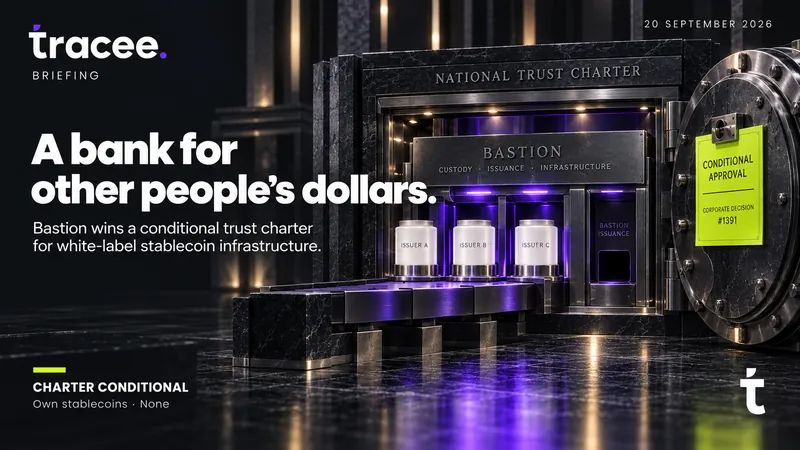
The OCC conditionally approved Bastion's national trust charter on 18 September, Corporate Decision #1391.
Read briefing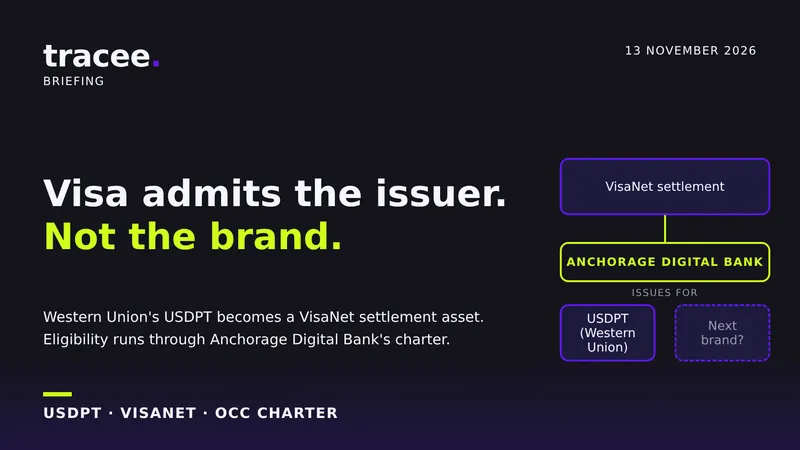
USDPT, issued by Anchorage Digital Bank for Western Union, is now a VisaNet settlement asset, under a framework that can extend to every stablecoin Anchorage issues.
Read briefing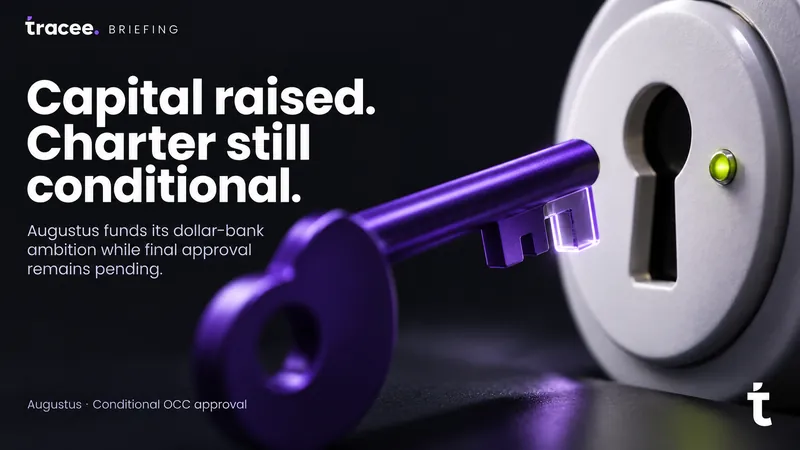
The Finland-based euro clearing business behind the raise is real and revenue-generating.
Read briefing
The new bank custodies digital assets for Circle and its own affiliates under direct federal supervision.
Read briefing
Coinbase and Moov gave 1,000-plus community banks and credit unions stablecoin payment infrastructure five days before the Senate's Clarity Act cloture vote.
Read briefing
Block filed 4 September for a second bank charter, Builders Bank, an uninsured trust bank barred from taking deposits or making loans.
Read briefingSuggest a news item or request a private briefing.
Public briefings publish on no fixed cadence. Private briefings, written for one institution and one decision, are part of the consulting engagement formats.
Discuss your projectBook a discovery call